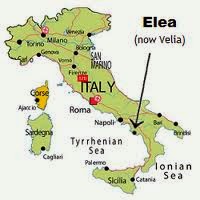
Leucippus of Miletus studied under Zeno of Elea - Elea was a Greek city in Southern ITALY!!!
Italian name Velia on the Tyrrhenian coast of the Lucania in Campania. Founded 540 BC by Phoenicians from Corsica. In 88 BC the city was conquered by the Romans and soon became a regional center. The citizens of Elea were Roman citizens, but were able to retain Greek language and customs.
Let's start there... Zeno was close to Parmenides* a philosopher from Elea.
Elea - quite lovely...
http://www-groups.dcs.st-and.ac.uk/~history/Biographies/Zeno_of_Elea.html
Zeno's 40 Paradoxes -
http://plato.stanford.edu/entries/paradox-zeno/
So there weren't actually 40, but they were all refutable via logic. Only about 10 survive. These guys were dabbling with big ideas and I am not taking away from what they did, it's just hard to puzzle through from this website. The site does include a nice bibliography to look into for further clarification. It's just not a straight forward as Leucippus and Democritis. Here's a brief summary without the confusion:
Italian name Velia on the Tyrrhenian coast of the Lucania in Campania. Founded 540 BC by Phoenicians from Corsica. In 88 BC the city was conquered by the Romans and soon became a regional center. The citizens of Elea were Roman citizens, but were able to retain Greek language and customs.
 |
| Castelluccio (Little Castle) |
 |
| Theatre |
Let's start there... Zeno was close to Parmenides* a philosopher from Elea.
 |
| Zeno of Elea |
Elea - quite lovely...
http://www-groups.dcs.st-and.ac.uk/~history/Biographies/Zeno_of_Elea.html
Zeno's 40 Paradoxes -
http://plato.stanford.edu/entries/paradox-zeno/
So there weren't actually 40, but they were all refutable via logic. Only about 10 survive. These guys were dabbling with big ideas and I am not taking away from what they did, it's just hard to puzzle through from this website. The site does include a nice bibliography to look into for further clarification. It's just not a straight forward as Leucippus and Democritis. Here's a brief summary without the confusion:
- Paradoxes of Motion
- Achilles and the Tortoise
- The Arrow
- The Dichotomy or The Racetrack
- The Moving Rows or The Stadium
- Paradoxes of Plurality [Plurality - the existence of many things versus one]
- Alike & Unalike
- Limited & Unlimited - The Paradox of Denseness
- Large & Small
- Infinite Indivisibility
- Other Paradoxes
- The Grain of Millet
- Against Place
Paradoxes of Motion:
1a. Achilles and the Tortoise - On a linear path, Achilles will never be able to reach the tortoise. It hits at the conditions for a continuum and the convergence of a limit of an infinite sequence. There are incremental steps that can never be completed to infinity.
1b. The Arrow - is not really moving. Challenging our common sense concepts of time and space. The assumption here is time is composed of moments, therefore the arrow does not move. An arrow must occupy a space equal to itself at any moment. At any moment, it is where it is. The places it occupies do not move. So if at each moment an arrow is occupying a space equal to itself, it is not moving in that moment as it has no where to go. Clever argument... implausible as it is.
1c. The Dichotomy or The Racetrack - Each runner will never reach their goal line on the racetrack. Incrementally the runner will never get there. A fixed point in time due to infinity, never reaching the end.
1d. The Moving Rows or The Stadium - It takes a body moving at a given speed a certain time to traverse a fixed length. Passing a body again at the same speed will take the same amount of time. Bodies are equidistant from each other, but are moving away from each other. Moving bodies pass through stationary bodies. (Not unlike the Heisenburg Uncertainty Principle - stating that there is space between all molecules. Developed in the late 19th century.)
Paradoxes of Plurality:
2a. Alike & Unalike - I like this one, even though it is considered one of Zeno's weakest Paradoxes. "If things are many, they must be like and unalike. But that is impossible; unlike things cannot be like, no like things unalike." But on the molecular level it could be true. Common properties of unalike elements. This has been proven false by modern day science, but for back then it was some pretty different thinking. Zeno then concludes, "the same thing is many and one, we shall instead say he is proving something is many and one, not that unity is many and plurality is one."
2b. Limited & Unlimited - The Paradox of Denseness - Zeno would prove one thing and then the opposite.
Parmenides - There are definite, fixed number of things in the universe. Therefore, they are limited.
Corollary by Zeno: But if there are many things, they must each be distinct and to keep them distinct there must be something separating them. Between the things there must be things. So, there mustn't be a definite of things, unlimited.
2c. Large & Small - flawed reasoning
*Parmenides - Many things exist, rather than just one thing - Pluralism* - must have a non-zero size.
Zeno - Then every part of any plurality is both so small as to have no size, but also so large as to have infinite size. Things were composed of parts that were not plural. (Yet things that are not pluralities cannot have size or they would be divisible into parts and be plural themselves.)
Parts have non-zero size. Each part has sub-parts, which have size. Sum of the sub-parts is infinite. eg. universe is an example of a plurality - composed of parts that are not plural.
*Debate between Pluralism and Monism
2d. Infinite Divisibility - most challenging paradox
An object can be divided into a plurality of parts. Zeno - Reassembly problem - Over lapping parts and sub-divide them further until they cannot be sub-divided anymore. These basic building blocks Zeno called Elements. The statements below illustrate the paradox, but lead to absurdity.
Other Paradoxes:
3a. The Grain of Millet - A bushel of millet falls to the ground and makes a noise. (Is this like our modern if a tree falls in the forest and there is no one there to hear it...) The bushel is composed of individual grains and those individual grains make a noise together. But individual grains do not.
My Thoughts On Zeno:
From this you can see how Leucippus, who studied with Zeno, could have formulated his ideology/philosophy. And hence forth down the line to Democritis. Democritis really put things into perspective for Epicurean and Lucretius. (Just my opinion.) Aristotle was not the biggest fan of Zeno. Much of what we know of Zeno comes from Aristotle's writings refuting, disproving Zeno's Paradoxes. None-the-less, I think Zeno is charming. He would have been great fun to talk to at a cocktail party. The smart guy with the boe tie who won't be quiet!
The beauty in Zeno's Paradoxes they are absurd, but they make you think out of the box.
1a. Achilles and the Tortoise - On a linear path, Achilles will never be able to reach the tortoise. It hits at the conditions for a continuum and the convergence of a limit of an infinite sequence. There are incremental steps that can never be completed to infinity.
1b. The Arrow - is not really moving. Challenging our common sense concepts of time and space. The assumption here is time is composed of moments, therefore the arrow does not move. An arrow must occupy a space equal to itself at any moment. At any moment, it is where it is. The places it occupies do not move. So if at each moment an arrow is occupying a space equal to itself, it is not moving in that moment as it has no where to go. Clever argument... implausible as it is.
1c. The Dichotomy or The Racetrack - Each runner will never reach their goal line on the racetrack. Incrementally the runner will never get there. A fixed point in time due to infinity, never reaching the end.
1d. The Moving Rows or The Stadium - It takes a body moving at a given speed a certain time to traverse a fixed length. Passing a body again at the same speed will take the same amount of time. Bodies are equidistant from each other, but are moving away from each other. Moving bodies pass through stationary bodies. (Not unlike the Heisenburg Uncertainty Principle - stating that there is space between all molecules. Developed in the late 19th century.)
Paradoxes of Plurality:
2a. Alike & Unalike - I like this one, even though it is considered one of Zeno's weakest Paradoxes. "If things are many, they must be like and unalike. But that is impossible; unlike things cannot be like, no like things unalike." But on the molecular level it could be true. Common properties of unalike elements. This has been proven false by modern day science, but for back then it was some pretty different thinking. Zeno then concludes, "the same thing is many and one, we shall instead say he is proving something is many and one, not that unity is many and plurality is one."
2b. Limited & Unlimited - The Paradox of Denseness - Zeno would prove one thing and then the opposite.
Parmenides - There are definite, fixed number of things in the universe. Therefore, they are limited.
Corollary by Zeno: But if there are many things, they must each be distinct and to keep them distinct there must be something separating them. Between the things there must be things. So, there mustn't be a definite of things, unlimited.
2c. Large & Small - flawed reasoning
*Parmenides - Many things exist, rather than just one thing - Pluralism* - must have a non-zero size.
Zeno - Then every part of any plurality is both so small as to have no size, but also so large as to have infinite size. Things were composed of parts that were not plural. (Yet things that are not pluralities cannot have size or they would be divisible into parts and be plural themselves.)
Parts have non-zero size. Each part has sub-parts, which have size. Sum of the sub-parts is infinite. eg. universe is an example of a plurality - composed of parts that are not plural.
*Debate between Pluralism and Monism
2d. Infinite Divisibility - most challenging paradox
An object can be divided into a plurality of parts. Zeno - Reassembly problem - Over lapping parts and sub-divide them further until they cannot be sub-divided anymore. These basic building blocks Zeno called Elements. The statements below illustrate the paradox, but lead to absurdity.
- Elements are nothing -
- Original objects are nothing
- Object is a mere appearance
- Elements are something -
- Original object composed of elements of zero size
- Elements are something, but do not have zero size
- Object can be further divided
Other Paradoxes:
3a. The Grain of Millet - A bushel of millet falls to the ground and makes a noise. (Is this like our modern if a tree falls in the forest and there is no one there to hear it...) The bushel is composed of individual grains and those individual grains make a noise together. But individual grains do not.
- If the millet or millet parts make a noise, then the smaller parts should make a noise.
My Thoughts On Zeno:
From this you can see how Leucippus, who studied with Zeno, could have formulated his ideology/philosophy. And hence forth down the line to Democritis. Democritis really put things into perspective for Epicurean and Lucretius. (Just my opinion.) Aristotle was not the biggest fan of Zeno. Much of what we know of Zeno comes from Aristotle's writings refuting, disproving Zeno's Paradoxes. None-the-less, I think Zeno is charming. He would have been great fun to talk to at a cocktail party. The smart guy with the boe tie who won't be quiet!
The beauty in Zeno's Paradoxes they are absurd, but they make you think out of the box.
Other Fun Fact pertaining to Zeno -
- Zeno and Socrates were contemporaries - Cool!
- Zeno was 40 - born around 490 BC (deduced from Socrates birth date of 469 BC)
- Socrates was 20 when he associated with Zeno
- What is know about Zeno can be found in the beginning of Plato's book on Paremenides
- Zeno writes a book defending Parmenides philosophy
- The book does not survive
- 10 of the 40 Paradoxes do survive
- Zeno was a student of Parmenides
- Zeno was dedicated to refuting arguments
- Contradictory consequences
- Against plurality, reality of the empirical world
*Parmenides -
5th century philosopher from Elea. Father of Eleatic School of Philosphy. Parmenides was in essence a thinker. He wrote a metaphysical poem(s) that challenged men's thinking at the time.
Neither poem survived. He was trying to understand nature around him and the world in general. It is or is not. Common sense belief in the reality of the physical world. A world of plurality and change. Distinction between appearance and reality, between opinion and knowledge. He was pre-Socratic in thinking.
In conclusion thus far, it strikes me that these guys were thinking deep thoughts without the benefit of modern mathematics. From being a science person my entire life, I see things through different eyes then most. It's binary is one of my favorite sayings. Math is a language to understand what is going on around us. Things can be proven by math. These guys came to the conclusions they did from the other side, without mathematics. Things were not binary to them, they were ever changing. Therefore the conclusions they came to without the benefit of math are mind blowing to me.
You can also see, partially, the evolution of thought on the origin of the atomist theory. Parmenides, Zeno, Leucippus, Democritis (I'll get to him later), Epicurian, & our beloved Leucritis! Thank You Pogio :)
As usual, late for something... this time work. More later. PD
 |
| Parmenides of Elea |
- The Way of Truth
- The Way of Opinion
Neither poem survived. He was trying to understand nature around him and the world in general. It is or is not. Common sense belief in the reality of the physical world. A world of plurality and change. Distinction between appearance and reality, between opinion and knowledge. He was pre-Socratic in thinking.
You can also see, partially, the evolution of thought on the origin of the atomist theory. Parmenides, Zeno, Leucippus, Democritis (I'll get to him later), Epicurian, & our beloved Leucritis! Thank You Pogio :)
As usual, late for something... this time work. More later. PD


