Monday, November 3, 2014

The Etruscans by Barker and Rasmussen - Dry But Good

After reading several books on Tuscany and Chianti, I took this book with me on my journey to India.  Go to India, read about pre-Roman Italy or the Etruscans.  Makes perfect sense!  For me anyway.

The book is good, but dry.  I am enjoying it.  It took me a while to get into, but once I did, I don't want to put it down.  The book goes into the history of the Italian peninsula on a grand scale, starting 50,000 years ago.  We quickly move into the Etruscans.  The book suggests the parallels to the Greek culture, no secret there and goes into great detail on the political, economic and social aspects  the two groups.  Furthermore, there is a reoccurring theme of archaeology versus histories.  [Polybus, Livy, Pliny and Tacitus, written from 2nd century BC to 2nd century AD.]

The Greeks and Phoenicians established colonies in Italy in 700 BC.  The Phoenicians established themselves in and traded with:
  • North Coast of Africa
  • Western Sicily
  • Sardinia
  • Southern Spain
Whereas, Greeks established themselves in and traded with:
  • Southern Italy
  • Eastern Sicily
  • Corsica
  • Southern France 
  • Eastern Spain
"In Italy the first Greek colony was established from the island of Euboea at Pithekoussai (or Pithacusa) on the island of Ischia in the Bay of Naples in 750 BC." p75 There was another colony of Greeks near Naples in 700 BC.  These were all established as Greece was growing stronger as trading power [economy] and needed room to grow/trade.  This again goes to my theory that southern Italy was initially Greek and hence the love of anything Greek.  These people mingled with the locals and became the Latins.

There are several theories as to where the Etruscans came from.  I am going to go with the migration down over the Alps, from the northern part of Europe or indigenous people's locally who banded together over time.

Map of Etruria and it's People
Three major structural features of the Landscape are the Apennines, Pre-Apennines and Anti-Apennines are limestone hills running the length of central Italy.  The eastern boundary is today's Autostrada between Florence and Rome.  Over time, the Etruscans developed hill top villages as defensible locations to other groups.  These groups were initial subsistence farmers growing cereal and grains to live.  But over time started growing olives and grapes (for wine) additionally.  They kept animals to feed themselves and for secondary products.  Economically, the biggest reason for growth was the mineral resources available in the Tuscan/Chanti region.  This spurred development of industry and trade.

As time progressed and the Villanovan Age occurs, a fuedal-like, Chiefdom systems evolve.  Over time, a prestige/ranking system develops, that is very elaborate in the Villanovan Era.  Burial rituals are high lighted.  Going from burial to cremation and ornate rituals.

Ages and Dates as Related to the Etruscans
Much of what historians know come from the tombs of the Etruscans.  Like the information on ranking on the various implements and ornaments buried with the cremated remains of the people.  There are more male graves then female, but the female graves exist non the less.

Women enjoyed much freedom.  Some were educated and could read.  Hair styles were Greek inspired.  They wore the forerunner of a toga.  There were brooches or fibulas to hold mantles or tunics together.  There was much ornamentation in the jewelry.  The text does not state if women could own land as their Greek and later Roman counterparts could.  (The information starts around p. 108 in the text.)

Alphabet - Again based on the Greek.  There is a lively discussion about the change of the alphabet over time and how that helps designate Norhtern Etruscans from Southern Etruscans.  (page 87-89)

Etruscan Alphabet
Ok- This is a summary of the first 1/3 of the book/PD- Pick up with Chapter 4.

I'm back, but quickly...  Lots more to say about this, but it's been a rough weekend - Cmon the Eagles even lost :(

Romaninization meant putting up walls, to keep the Romans out!  Many of the cities in Eutria were not fortified until the Roman expansion:  Roman Civil War, [Marius-lost] and Sulla's-won terror's [to those who opposed him] were cited.  (But it really occurred earlier in the 2nd century BC when the Romans conquered Veii(396 BC), Volsinii (264 BC) and Falerii (241 BC).)  The farms dried up at the same time.  The book states 80% of the farms dried up in Falerii and 33% of the farms near Veii. Certain areas south of Rome did thrive though, along the trade/market routes (to Rome.)   The book mentions some cities remained relatively untouched by the Roman invaders:  Tarquinia.  This could be because it was heavily involved in the trade routes?

What fascinates me is the evolution of the polis or the cities along the trade route and the fact the book mentions some of the farm areas that were abandoned during the Romanization period, were reclaimed during the middle ages.  This leads the reader to believe, the Etruscans were a peaceful, or atleast more so, than the Romans.  And it is fair to say, their independence and cultural development ended in the 2nd century BC after being swallowed up by the Romans.

Also, characteristic to Romanization, wealthy Etruscan families were offered Roman citizenship.  In 89 BC, after the Civil War, the Etruscans were given citizenship and taken into the Roman tribes.  Several wealthy families (farming) even made the transition to the Roman Villa life style.  The Etruscan farms were in their hey day in the 2nd cent BC and some went into the Republic and Early Empire.

Note:  Veii is 15 km from Rome, in other words, very close.  Conquered by Rome in 396 BC.

Reference:  In the Name of Rome by Goldsworthy & From Gracchi to Nero by Schullard.
I NEED MORE TIME TO READ  :-)

Update:  I just got Etruscan Civilization by Sybille Haynes in the mail!!  Such a cool and more comprehensive book.  I can add sections to this entry based on this book.  Stay tuned.  And the pictures are wonderful :)

Roman Roads:  All Roads lead to Rome!  But they were first Etruscan Roads used for trade between cities.  The first Roman Road cited by the book is Via Amerina, layed out after the destruction of Falerii in 241 BC.  Followed by Via Flaminia, 220 BC and Via Aurelia in the 2nd or 1st cent BC all used to move Roman troops around for the great expansion of the Republic.  Diverticula - side roads - I found this funny, I don't know why...

Etruscan Influences on Roman Life
1. fasces - folding chair
2. Etruscan Alphabet - Latin alphabet was derived from Greek.  (Latin official language of Rome.)
3. Etruscan Mantle - Roman Toga
4. Etruscan Burial Ash Urns - Roman burial & Imperial Sarcophagus with mythological embellishment
5. Public Sporting Events
6. Arch - Falerii cited
7. Aqueducts & rudimentary drainage systems

Saturday, October 25, 2014

Seven Seasons in Sienna by Robert Rodi - Nice!

Seven Seasons in Sienna:  My Qixotic Quest for Acceptance Among Tuscany's Prodest People by Robert Rodi is another good book to read in line with Too Much Tuscan Sun.  Rodi was a co-writer or assisted Dario Castagno in the writing of his book(s).  Rodi story is less short stories and more narrative of his many visits to Sienna and his desire to be apart of the contrada.  Specifically the Caterpillar contrada, that Castagno is a member.  Rodi and Castagno are obvious friends.  (Personal Observation:  Friends or a friendship that can stand time and distance is a wonderful thing.  I think of that as I read the book and some of the narratives within.)

Sienna, Piazza del Campo - Lovely Medieval City

I am enjoying Rodi's writing style and can see echoes of it in Castagno's books.  (I have just ordered several more and cannot wait to receive and start reading them.  I just gave my copy of Too Much Tuscan Sun to someone to read.)  There is also a long standing Rivalry between Florence and Sienna where Sienna lost in 1555, when this book alleges "Florence put Sienna under oppressive rule and cut them off from outside influence.' [p. 9] This makes the Siennese a proud people, not too crazy about the Florentines.  These books are upbeat and fully of history, this one specifically on the palio.

Palio Facts - https://www.youtube.com/watch?v=3_yGZhZItVo [link to video of the palio]


Piazza del Campo transformed into a racetrack for the palio
  • Two Palio each year to celebrate the Madonna
    • July 2 - Madonna of Prvenzano [p.43]
    • August 16 - Feast of the Assumption [p. 43]
    • Only 10/17 race in each palio as there isn't enough room for all of them to run
    • "Two lottery drums, one containing the names of the ten racing contrade, the other names of the ten horses." [p. 39]  It's all put together by chance.
    • The remaining 3 contrade are randomly selected to run
    • The race is run in the Piazza del Campo (center of town) and is shell shaped, meaning prosperity in the middle ages.  Palazzo Publico and Torre del Mangia are the main buildings in the Piazza.
    • Piazza del Campo is turned into a race track over night as dirt is put down by dump truck for the horses to race on.
    • The horses take 3 turns around the race track.  (The sharp turn in the video is the Curva di San Martino.)  In the past many horses have wiped out there.  Horses can cross the finish line and win without the jokey on back.
  • Horses 
    • After running in the palio, the horses are entitled to retire to a pensionario where they can run free and are well cared for
    • Average life span of a palio horse is 28 years
    • Only half breed horses are selected between the ages of seven and ten years
    • There are protocols to prevent accidents
    • Sienna works with animal rights groups to ensure the excellent treatment of the horses
    • The same cannot be said of the jokey's - they are either loved or hated... 
  • Contrada - city quarter - there are 17 in Sienna; where as there are 3 sections of the city
    • 17 Quarters - Eagle, Snail, Owl, Dragon, Giraffe, Porcupine, She-Wolf, Seashell, Goose, Caterpillar, Wave, Panther, Forest, Tortoise, Unicorn, Tower and Ram
    • 3 Districts - Terzo di Camollia, Terzo di Citta and Terzo di San Martino [p. 43]
    • There are rivalries between certain contradas
    • Certain contrada were at one time made up of the tradesmen in the quarter
    • Today membership in the contrada is based on the quarter of the city you are born in.  Families can be split among several contradas.  Therefore, according to D. Castagno, contradas are another type of family.
    • Members work their way up the ranks of the contrada from KP to leadership positions
  • Drappellone, painted banner given to the winner of the palio
    • Designed by various artist from Sienna and elsewhere
  • Fazzoletto - scarf tied around the neck of the member of the contrada to designate which contrada they are a member of.  eg. Caterpillar colors are blue, gold and green
Symbol of the Caterpillar Contrada

More on the book...
There is one chapter in Summer 2009 - The Debutantes - Out of Pocket, where Rodi looses his wallet in the airport at Pisa and then looses his luggage in a cab he cannot pay for.  Travel Nightmare 101!  He has friends that help and support him.  A great thing in life.

Another chapter in the same section A lot of Chianti, A Little Rose (this one sprung me out of bed at 6 am to write this entry) has a quote that got to me.  Context:  Rodi is at the Caterpillar contrada and meets Peggy Castaldi, an American from San Francisco who lives part-time in Sienna.  She is a member of the contrada.  "She is bright and funny...  and seems to mesh seamlessly with the natives.  I ask her what her secret is, and she looks at me oddly. "Just being here," she says, as if obviously that's all it takes; and I can see that it might be all it takes her.  Some people are like open windows; there no artifice, no expectation, no apprehension in them - they joyfully embrace any new experience. [Of the Author] I'm not an open window, not even a shuttered one.  I feel more like the trap door to the cellar with the padlock that is rusted shut.  Got to get a crowbar and pry that baby open."  [p. 98]

Wow, that made me think.  First, "joyfully embracing any new experience," does that indicate a certain naivete in Peggy or does it indicate a strong woman who can take what comes into her path.  Is it a combination of both?  (I haven't met her, but I will go with a combination of the two the latter being the stronger characteristic.)  Secondly, can you vacillate between the two extremes?  Would that be bi-polar or just plain old humanity?  (I'm again hoping for the latter.)  Openness is a quality that many Americans lack.  We are hooked into buy me, take me, give me at the mall; whereas many Europeans value slowing down and enjoying life.  We rush, rush, rush as we accumulate our many possessions and bucket lists.  Can you see where I'm going with this?  Maybe it's just me and where I'm at now, but it really hit me hard.  Be strong, enjoy life.  Work hard, play hard and enjoy your family while you can.

I also really like the word quixotic in the title.  The word means exceeding idealistic, unrealistic and impractical.  But as Rodi writes, you feel his goal is ever more in reach.  Could he become a member of the Caterpillar contrada by the end of the book?  I hope so, just like Roy Moskovitz (of Too Much Tuscan Sun.)

Listening to Bach Concerto for Harpsicord No. 1 in D Minor (https://www.youtube.com/watch?v=CjSD12OQbFA) as I write, but only half way through, more later/PD
_________________________________________________________________________________
Pictures from Recent Trip to Sienna


Armor from Caterpillar Contrada

Caterpillar

Caterpillar Contrada Museum

Inside Catarpillar Contrada Museum

Catarpillar Contrada Museum

Catarpillar Contrada Museum

Winning Palio Banners


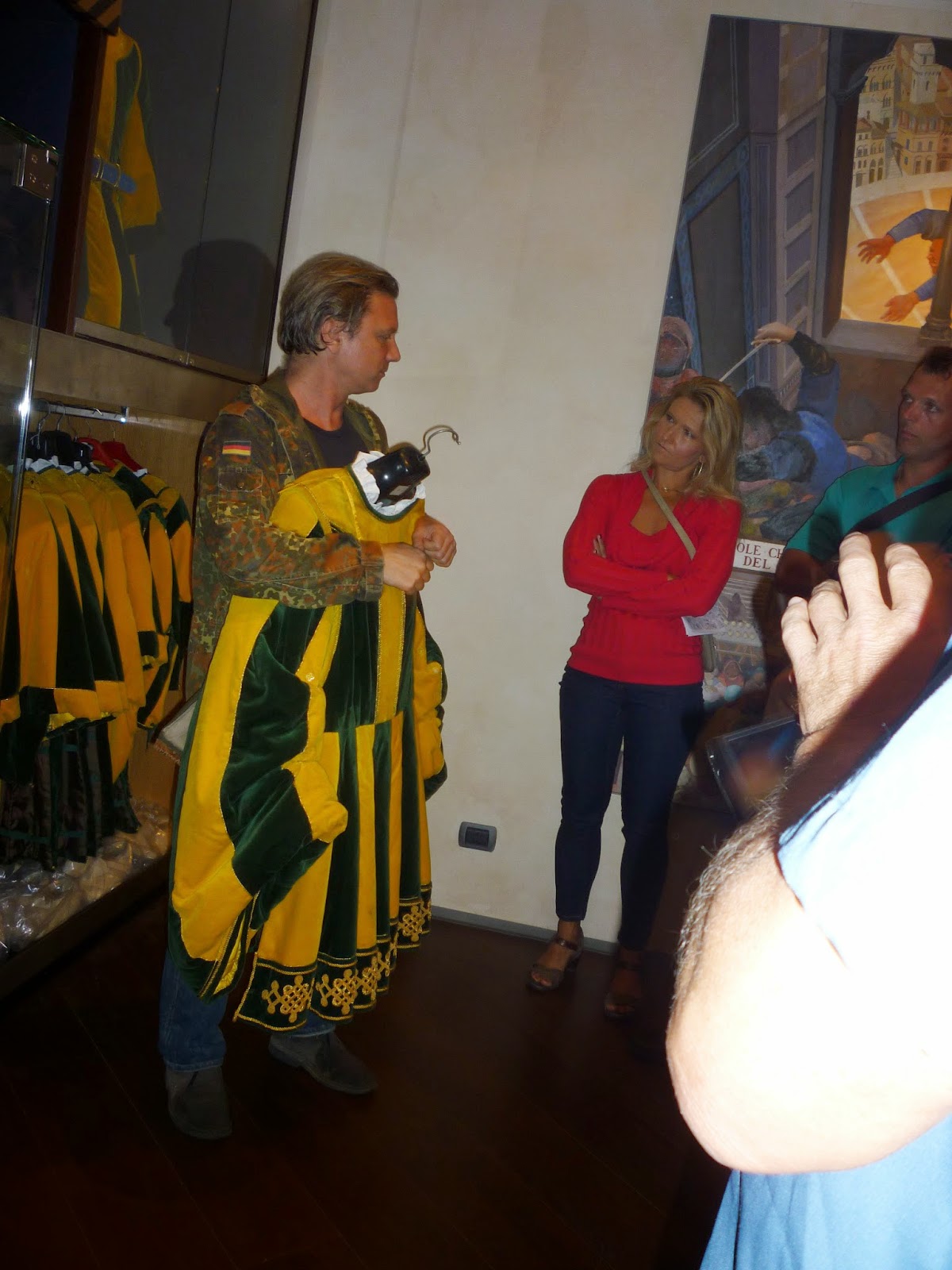
Dario giving the tour of the Contrada

Winning Palio Banners from 1837 & 1838

Friday, October 24, 2014

Too Much Tuscan Sun by Dario Castagno - READ IT!!!

Too Much Tuscan Sun: Confessions of a Chianti Tour Guide by Dario Castagno was a super-duper Feel Good/Awesome book.  So many funny stories about his clients and local history of the area.  On a recent trip I was able to meet Dario and actually tour the Caterpillar contrada.  So very cool.

Readit/Readit/Readit - It will take you to Sienna and the lovely Italian country-side, if only in an arm chair, and make you laugh all at the same time.


Defending Jacob - Will It Ever End???

Defending Jacob by William Landay was my book clubs book for Oct 2014.  I could NOT finish it.  It never ended...  400 pages of Turrow-who-wants-to-be-Grisham-esque courtroom drama.  Aye Vey, I couldn't take it.  I know there's a surprise ending, but I cannot reach the end of this novel.

Just Sayin'

Thursday, July 3, 2014

Factors Contributing to Caesar's Demise...

After reading about Caesar and his military conquests, I have began to wonder why and this great man was not more informed about a plot against his life. [The author has started to refer to Caesar as "The Dictator."  This puts visions of Caesar marching around as Charlie Chaplin in his robes.  Funny notion.]  Furthermore, the author refers to it as a conspiracy, not a coup as I have come to view it.  A coup for the good of Rome.  Had Caesar put an end to the conspiracy or coup, the history of the Roman Republic would have turned out much differently.

Caesar's "duty" was to restore the [Roman] Constitution for the good of the Republic.  The conspiracy against Caesar started one year prior to his death, March 15, 44 BC.  There was a strong disaffection among the ruling class.  There were up to 60 people involved in the effort to kill Caesar.  They called themselves Freedom Fighters (Liberatores,) they were dissatisfied with the immense death toll from the recent civil war.  At the Battle of Munda there were 30,000 deaths alone.  Pompey's son Cneaus was killed in this fighting with his troops.

In addition to the political unrest, the treasury was bankrupt from fighting the civil war.  A further strain was the cost of administering a larger republic and the food supplements handed out in Rome and elsewhere in the republic.  And Anthony's mismanagement of the government during Caesar's absence during the civil war and while in Egypt.

On of the other contributing factors, in my opinion, was the death of Cato.  When Cato killed himself, it was a big blow to Caesar's reputation.  Cato was respected in the Senate and by the Optimates; but that someone would take his life for dignity and honor really hit the heart of what Caesar was trying to do.  Then the publication of Cato by Cicero, Anti-Cato by Caesar and the pamphlet by Brutus did not do Caesar well in the public eye.

Lastly, when the author refers to Caesar as "Dictator," he was not really.  He turned down the opportunity "officially" when the Senate offered it to him, but he was acting the role.  Nothing upset the Roman people more then the idea of a king or dictator for life.  Caesar should have know that from his powers of working with people and command in the military.  Maybe the military service also kept him thinking he was in charge and unstoppable.  That I don't know.

Note on the civil war:  estimated 100,000 Roman citizens had lost their lives since 49 BC.  Certain citizens viewed the civil war as two great generals going at each other for power.  Pompey, representing the Optimates, the conservative faction and Caesar, representing the Populares, the people.  Therefore the large death toll was uncalled for.

People mentioned in the conspiracy:
Caius Trebonius - Governor of Spain - asked Mark Anthony if he would join plot to kill Caesar
Mark Anthony - ran Italy in Caesar's absence - Remained silent when approached by Trebonius
Marcus Brutus
Caius Cassius Longius - Quaestor - Taken over Syria after Crassus's death at the Battle of Carrhae - Success with respect to Parthians in 51 BC when Cicero was Governor of Cilicia a neighboring province

Wednesday, July 2, 2014

And the Mountains Echoed by Khalid Hosseini

Wyckfield Book Group - July Selection
Setting:  Maidan Sabz - rural village outside of Kabul in the 1950s

Cast of Characters:
Baba Saboor Ayub - father
1st wife dies in child birth

  • Abdullah - son
  • Quais - son taken by div/educated
  • Pari - daughter - collects feathers

Parwana - Second Wife
Masooma - Parwana's sister
Nabi - Parwana's brother and chauffeur to Wahdati family in Kabul
Of Mrs. Wahdati - from chapter 2 - "Abdullah looked at her and sensed something alarming in the woman, beneath the makeup and the perfume and the appeals for sympathy, something deeply splintered." (p 43)

Opening Quote:
"Out beyond ideas of wrong doing and right doing, there is a field.  I will meet you there."  Jelaluddin Rumi, 13th century

Darul Aman Palace - mentioned in chapter 3 - where Masooma would like to go

Darul Aman Place

From Wikipedia - http://en.wikipedia.org/wiki/Darul_Aman_Palace
Darul Aman Palace ("abode of peace" or, in a double meaning "abode of Aman[ullah]")[1] is a European-style palace, now ruined, located about sixteen kilometers (ten miles) outside of the center of KabulAfghanistan.
Darul Aman Palace was built in the early 1920s as a part of the endeavours of King Amanullah Khan to modernize Afghanistan. It was to be part of the new capital city (also called Darul Aman or Darulaman) that the king intended to build, connected to Kabul by a narrow gauge railway.[2] The palace is an imposing neoclassical building on a hilltop overlooking a flat, dusty valley in the western part of the Afghan capital. Intended as the seat of a future parliament, the building was unused for many years after religious conservatives forced Amanullah from power and halted his reforms.
The inside of the palace is in very bad shape. Photo taken July 2010.
Darul Aman Palace was gutted by fire in 1969. It was restored to house the Defence Ministry during the 1970s and 1980s. In the Communist coup of 1978, the building was set on fire. It was damaged again as rival Mujahideen factions fought for control of Kabul in the early 1990s. Heavy shelling by the Mujahideen after the end of the Soviet invasion left the building a gutted ruin.
In 2005, a plan was unveiled to refurbish the palace for use as the seat of Afghanistan's future parliament.[3] It was to be funded primarily by private donations from foreigners and wealthy Afghans. As of July 2010 there were no signs of renovation of the palace. The palace was reportedly part of the targets in attacks launched on 15 April 2012 for which the Taliban claimed responsibility.[4]
On a hill near the Darul Aman Palace stands the Tajbeg Palace, built as a residence for Amanullah, his wife, Queen Soraya, and their family.

Tuesday, July 1, 2014

The Kiss by Rodin - Took My Breath Away

I saw The Kiss by Rodin for the first time a week ago.  It took my breath away! 


When I first walked into the Rodin Museum with my daughter in Philadelphia I did not know what to expect.  Small vestibule.  Admission.  An iPod as a tour guide.  I walked in and turned the corner and saw a woman prostrate with her back and bottom facing me in white.  I was amazed by her back.  You could see nothing, but everything.  You could feel her cringe.

I turn another corner and it's there.  The Kiss.  I am transformed.  Smooth.  Turning.  White.  Romance.  Passion.  Sadness.  That moment right before submission to your partner.  [Francesca] did not dive in...  I did.  Amazement.  Fascination.  A symphony plays in the background.  I took many pictures of the sculpture.  From all angles.  Rodin wanted you to look at it from all sides.  Then I begin to wonder about the lovers story.  (I didn't know her name was Francesca at that time or I did from the iPod guide?)  

So then I actually listen to the iPod guide and it tells me about Paolo and Francesca and how she fell in love with him.  The brother of her husband.  It tells how Rodin initially intended the piece for the lower right hand corner for The Gates Of Hell.  A project he was working on.  That did not agree with what I saw before me.  Passion.  [Syn.  desire, hunger, craving, lust, urge, ache...  all view-able before me in Rodin's work.]  As time passed, Rodin removed the piece from The Gates of Hell and made it a stand alone piece.  It didn't fit.  (Yes, I understand that sentiment.) 

Raw emotion and passion are emotions elicited from The Kiss on first sight.  I also heard a symphony of lovely music.  Summer.  Four Seasons.  Vivaldi.  His hands lightly resting on her leg.  Doesn't that drive you crazy?  For some reason, earlier that day, I purchased a sketch book.  I drew my daughter as we were sitting down to rest.  She's an artist.  That's what she is studying in college.  Her comment to me, "I didn't know you did that."  My response, "it's been too many years."  It came back to me.  Like riding a bike.  I sat down at this point on a bench in front of The Kiss and started to sketch.  Minutes had passed, but it seemed much longer.  The drawing was slow at first, but then it continued.  Erase.  Re-draw.  ("That's why there are erasers on pencils kid." ~ CJF)    

The pictures I took are being developed and there will be more sketches.  I will go back to the Rodin Museum and be captivated again and again.  Life returns and it is good!  Summer will turn into fall and life, love will be found again.

Links:
Song - John Legend - All of Me - reminds me of this work
BBC Documentary - The Private Life of a Masterpiece - The Kiss - http://www.youtube.com/watch?v=L0UJ5BZOd_A
Rodin-web - http://rodin-web.org/works/1880_kiss.htm

More History:
Paolo and Francesca in their first kiss.  Before they could kiss, they were slain by Francesca's husband and Paolo's brother Giovanni and doomed to hell.  

In 1275, Francesca, daughter of Guida Vecchia da Polenta de Ravina, is arranged to marry Giovanni Malatesta, Lord of Rimini.  There were political reasons for the union.  Giovanni was physically deformed.  Francesca falls in love with Paolo, Giovanni's younger brother.  Giovanni does kill, stabs, Francesca and Paolo in a jealous fit of rage when he sees them kissing.  This is a huge scandal in Florence when it happens.  Dante is 17 at the time.  Francesca leaves behind a 9 year old daughter.  Paolo, also married, leaves behind 3 children and his wife.

The piece comes from Dante's Inferno, Canto V.  (I have tried reading the Inferno, I have it on my phone, but find it quite hard to understand.)  The lovers go to the second circle of hell where sinners are punished for all eternity.

No doubt Camille Claudel, Rodin's mistress is the muse for Francesca?  No, according to the BBC documentary.  The work was started 2 years before their affair did.  The two Italian sisters Anna and Adelle Abruzzezzi, with Adele being the most likely candidate as the model for the kiss.  

Originally the piece was designed for the commission of The Gates of Hell, but Rodin finally realizes the piece does not fit into the composition.  A 29 inch bronze version was first made for the project.  It was displayed at the World's Colombian Exposition for display.  It was considered risque for the late 1880's and was displayed in a separate room and view-able only by appointment.  Considered Eroticism.  

The French government commissioned a larger, marble version of the sculpture to be made in 1888.  Jean Turkin, Rodin's assistant, enlarges the piece into marble; but does not finish it.  He leaves Rodin's studio before it is finished.  Rodin finishes it.  

Initially displayed in the Salon de Societe Nationale de Beaux Arts in 1898.  In 1900 moved to the Musee de Luxemborg and in 1919 to the Musee Rodin in Paris, where it resides today.  There is a copy in the Barnes Foundation in Philadelphia, where I viewed, was transformed, by the piece.