After reading about Caesar and his military conquests, I have began to wonder why and this great man was not more informed about a plot against his life. [The author has started to refer to Caesar as "The Dictator." This puts visions of Caesar marching around as Charlie Chaplin in his robes. Funny notion.] Furthermore, the author refers to it as a conspiracy, not a coup as I have come to view it. A coup for the good of Rome. Had Caesar put an end to the conspiracy or coup, the history of the Roman Republic would have turned out much differently.
Caesar's "duty" was to restore the [Roman] Constitution for the good of the Republic. The conspiracy against Caesar started one year prior to his death, March 15, 44 BC. There was a strong disaffection among the ruling class. There were up to 60 people involved in the effort to kill Caesar. They called themselves Freedom Fighters (Liberatores,) they were dissatisfied with the immense death toll from the recent civil war. At the Battle of Munda there were 30,000 deaths alone. Pompey's son Cneaus was killed in this fighting with his troops.
In addition to the political unrest, the treasury was bankrupt from fighting the civil war. A further strain was the cost of administering a larger republic and the food supplements handed out in Rome and elsewhere in the republic. And Anthony's mismanagement of the government during Caesar's absence during the civil war and while in Egypt.
On of the other contributing factors, in my opinion, was the death of Cato. When Cato killed himself, it was a big blow to Caesar's reputation. Cato was respected in the Senate and by the Optimates; but that someone would take his life for dignity and honor really hit the heart of what Caesar was trying to do. Then the publication of Cato by Cicero, Anti-Cato by Caesar and the pamphlet by Brutus did not do Caesar well in the public eye.
Lastly, when the author refers to Caesar as "Dictator," he was not really. He turned down the opportunity "officially" when the Senate offered it to him, but he was acting the role. Nothing upset the Roman people more then the idea of a king or dictator for life. Caesar should have know that from his powers of working with people and command in the military. Maybe the military service also kept him thinking he was in charge and unstoppable. That I don't know.
Note on the civil war: estimated 100,000 Roman citizens had lost their lives since 49 BC. Certain citizens viewed the civil war as two great generals going at each other for power. Pompey, representing the Optimates, the conservative faction and Caesar, representing the Populares, the people. Therefore the large death toll was uncalled for.
People mentioned in the conspiracy:
Caius Trebonius - Governor of Spain - asked Mark Anthony if he would join plot to kill Caesar
Mark Anthony - ran Italy in Caesar's absence - Remained silent when approached by Trebonius
Marcus Brutus
Caius Cassius Longius - Quaestor - Taken over Syria after Crassus's death at the Battle of Carrhae - Success with respect to Parthians in 51 BC when Cicero was Governor of Cilicia a neighboring province
Thursday, July 3, 2014

Wednesday, July 2, 2014
And the Mountains Echoed by Khalid Hosseini
Wyckfield Book Group - July Selection
Setting: Maidan Sabz - rural village outside of Kabul in the 1950s
Cast of Characters:
Baba Saboor Ayub - father
1st wife dies in child birth
Parwana - Second Wife
Masooma - Parwana's sister
Nabi - Parwana's brother and chauffeur to Wahdati family in Kabul
Of Mrs. Wahdati - from chapter 2 - "Abdullah looked at her and sensed something alarming in the woman, beneath the makeup and the perfume and the appeals for sympathy, something deeply splintered." (p 43)
Opening Quote:
"Out beyond ideas of wrong doing and right doing, there is a field. I will meet you there." Jelaluddin Rumi, 13th century
Darul Aman Palace - mentioned in chapter 3 - where Masooma would like to go
From Wikipedia - http://en.wikipedia.org/wiki/Darul_Aman_Palace
Setting: Maidan Sabz - rural village outside of Kabul in the 1950s
Cast of Characters:
Baba Saboor Ayub - father
1st wife dies in child birth
- Abdullah - son
- Quais - son taken by div/educated
- Pari - daughter - collects feathers
Parwana - Second Wife
Masooma - Parwana's sister
Nabi - Parwana's brother and chauffeur to Wahdati family in Kabul
Of Mrs. Wahdati - from chapter 2 - "Abdullah looked at her and sensed something alarming in the woman, beneath the makeup and the perfume and the appeals for sympathy, something deeply splintered." (p 43)
Opening Quote:
"Out beyond ideas of wrong doing and right doing, there is a field. I will meet you there." Jelaluddin Rumi, 13th century
Darul Aman Palace - mentioned in chapter 3 - where Masooma would like to go
 |
| Darul Aman Place |
From Wikipedia - http://en.wikipedia.org/wiki/Darul_Aman_Palace
Darul Aman Palace ("abode of peace" or, in a double meaning "abode of Aman[ullah]")[1] is a European-style palace, now ruined, located about sixteen kilometers (ten miles) outside of the center of Kabul, Afghanistan.
Darul Aman Palace was built in the early 1920s as a part of the endeavours of King Amanullah Khan to modernize Afghanistan. It was to be part of the new capital city (also called Darul Aman or Darulaman) that the king intended to build, connected to Kabul by a narrow gauge railway.[2] The palace is an imposing neoclassical building on a hilltop overlooking a flat, dusty valley in the western part of the Afghan capital. Intended as the seat of a future parliament, the building was unused for many years after religious conservatives forced Amanullah from power and halted his reforms.

Darul Aman Palace was gutted by fire in 1969. It was restored to house the Defence Ministry during the 1970s and 1980s. In the Communist coup of 1978, the building was set on fire. It was damaged again as rival Mujahideen factions fought for control of Kabul in the early 1990s. Heavy shelling by the Mujahideen after the end of the Soviet invasion left the building a gutted ruin.
In 2005, a plan was unveiled to refurbish the palace for use as the seat of Afghanistan's future parliament.[3] It was to be funded primarily by private donations from foreigners and wealthy Afghans. As of July 2010 there were no signs of renovation of the palace. The palace was reportedly part of the targets in attacks launched on 15 April 2012 for which the Taliban claimed responsibility.[4]
On a hill near the Darul Aman Palace stands the Tajbeg Palace, built as a residence for Amanullah, his wife, Queen Soraya, and their family.
Tuesday, July 1, 2014
The Kiss by Rodin - Took My Breath Away
I saw The Kiss by Rodin for the first time a week ago. It took my breath away!

When I first walked into the Rodin Museum with my daughter in Philadelphia I did not know what to expect. Small vestibule. Admission. An iPod as a tour guide. I walked in and turned the corner and saw a woman prostrate with her back and bottom facing me in white. I was amazed by her back. You could see nothing, but everything. You could feel her cringe.
I turn another corner and it's there. The Kiss. I am transformed. Smooth. Turning. White. Romance. Passion. Sadness. That moment right before submission to your partner. [Francesca] did not dive in... I did. Amazement. Fascination. A symphony plays in the background. I took many pictures of the sculpture. From all angles. Rodin wanted you to look at it from all sides. Then I begin to wonder about the lovers story. (I didn't know her name was Francesca at that time or I did from the iPod guide?)
So then I actually listen to the iPod guide and it tells me about Paolo and Francesca and how she fell in love with him. The brother of her husband. It tells how Rodin initially intended the piece for the lower right hand corner for The Gates Of Hell. A project he was working on. That did not agree with what I saw before me. Passion. [Syn. desire, hunger, craving, lust, urge, ache... all view-able before me in Rodin's work.] As time passed, Rodin removed the piece from The Gates of Hell and made it a stand alone piece. It didn't fit. (Yes, I understand that sentiment.)
Raw emotion and passion are emotions elicited from The Kiss on first sight. I also heard a symphony of lovely music. Summer. Four Seasons. Vivaldi. His hands lightly resting on her leg. Doesn't that drive you crazy? For some reason, earlier that day, I purchased a sketch book. I drew my daughter as we were sitting down to rest. She's an artist. That's what she is studying in college. Her comment to me, "I didn't know you did that." My response, "it's been too many years." It came back to me. Like riding a bike. I sat down at this point on a bench in front of The Kiss and started to sketch. Minutes had passed, but it seemed much longer. The drawing was slow at first, but then it continued. Erase. Re-draw. ("That's why there are erasers on pencils kid." ~ CJF)
The pictures I took are being developed and there will be more sketches. I will go back to the Rodin Museum and be captivated again and again. Life returns and it is good! Summer will turn into fall and life, love will be found again.
Links:
Song - John Legend - All of Me - reminds me of this work
BBC Documentary - The Private Life of a Masterpiece - The Kiss - http://www.youtube.com/watch?v=L0UJ5BZOd_A
Rodin-web - http://rodin-web.org/works/1880_kiss.htm
More History:
Paolo and Francesca in their first kiss. Before they could kiss, they were slain by Francesca's husband and Paolo's brother Giovanni and doomed to hell.
In 1275, Francesca, daughter of Guida Vecchia da Polenta de Ravina, is arranged to marry Giovanni Malatesta, Lord of Rimini. There were political reasons for the union. Giovanni was physically deformed. Francesca falls in love with Paolo, Giovanni's younger brother. Giovanni does kill, stabs, Francesca and Paolo in a jealous fit of rage when he sees them kissing. This is a huge scandal in Florence when it happens. Dante is 17 at the time. Francesca leaves behind a 9 year old daughter. Paolo, also married, leaves behind 3 children and his wife.
The piece comes from Dante's Inferno, Canto V. (I have tried reading the Inferno, I have it on my phone, but find it quite hard to understand.) The lovers go to the second circle of hell where sinners are punished for all eternity.
No doubt Camille Claudel, Rodin's mistress is the muse for Francesca? No, according to the BBC documentary. The work was started 2 years before their affair did. The two Italian sisters Anna and Adelle Abruzzezzi, with Adele being the most likely candidate as the model for the kiss.
Originally the piece was designed for the commission of The Gates of Hell, but Rodin finally realizes the piece does not fit into the composition. A 29 inch bronze version was first made for the project. It was displayed at the World's Colombian Exposition for display. It was considered risque for the late 1880's and was displayed in a separate room and view-able only by appointment. Considered Eroticism.
The French government commissioned a larger, marble version of the sculpture to be made in 1888. Jean Turkin, Rodin's assistant, enlarges the piece into marble; but does not finish it. He leaves Rodin's studio before it is finished. Rodin finishes it.
Initially displayed in the Salon de Societe Nationale de Beaux Arts in 1898. In 1900 moved to the Musee de Luxemborg and in 1919 to the Musee Rodin in Paris, where it resides today. There is a copy in the Barnes Foundation in Philadelphia, where I viewed, was transformed, by the piece.
When I first walked into the Rodin Museum with my daughter in Philadelphia I did not know what to expect. Small vestibule. Admission. An iPod as a tour guide. I walked in and turned the corner and saw a woman prostrate with her back and bottom facing me in white. I was amazed by her back. You could see nothing, but everything. You could feel her cringe.
I turn another corner and it's there. The Kiss. I am transformed. Smooth. Turning. White. Romance. Passion. Sadness. That moment right before submission to your partner. [Francesca] did not dive in... I did. Amazement. Fascination. A symphony plays in the background. I took many pictures of the sculpture. From all angles. Rodin wanted you to look at it from all sides. Then I begin to wonder about the lovers story. (I didn't know her name was Francesca at that time or I did from the iPod guide?)
So then I actually listen to the iPod guide and it tells me about Paolo and Francesca and how she fell in love with him. The brother of her husband. It tells how Rodin initially intended the piece for the lower right hand corner for The Gates Of Hell. A project he was working on. That did not agree with what I saw before me. Passion. [Syn. desire, hunger, craving, lust, urge, ache... all view-able before me in Rodin's work.] As time passed, Rodin removed the piece from The Gates of Hell and made it a stand alone piece. It didn't fit. (Yes, I understand that sentiment.)
Raw emotion and passion are emotions elicited from The Kiss on first sight. I also heard a symphony of lovely music. Summer. Four Seasons. Vivaldi. His hands lightly resting on her leg. Doesn't that drive you crazy? For some reason, earlier that day, I purchased a sketch book. I drew my daughter as we were sitting down to rest. She's an artist. That's what she is studying in college. Her comment to me, "I didn't know you did that." My response, "it's been too many years." It came back to me. Like riding a bike. I sat down at this point on a bench in front of The Kiss and started to sketch. Minutes had passed, but it seemed much longer. The drawing was slow at first, but then it continued. Erase. Re-draw. ("That's why there are erasers on pencils kid." ~ CJF)
The pictures I took are being developed and there will be more sketches. I will go back to the Rodin Museum and be captivated again and again. Life returns and it is good! Summer will turn into fall and life, love will be found again.
Links:
Song - John Legend - All of Me - reminds me of this work
BBC Documentary - The Private Life of a Masterpiece - The Kiss - http://www.youtube.com/watch?v=L0UJ5BZOd_A
Rodin-web - http://rodin-web.org/works/1880_kiss.htm
More History:
Paolo and Francesca in their first kiss. Before they could kiss, they were slain by Francesca's husband and Paolo's brother Giovanni and doomed to hell.
In 1275, Francesca, daughter of Guida Vecchia da Polenta de Ravina, is arranged to marry Giovanni Malatesta, Lord of Rimini. There were political reasons for the union. Giovanni was physically deformed. Francesca falls in love with Paolo, Giovanni's younger brother. Giovanni does kill, stabs, Francesca and Paolo in a jealous fit of rage when he sees them kissing. This is a huge scandal in Florence when it happens. Dante is 17 at the time. Francesca leaves behind a 9 year old daughter. Paolo, also married, leaves behind 3 children and his wife.
The piece comes from Dante's Inferno, Canto V. (I have tried reading the Inferno, I have it on my phone, but find it quite hard to understand.) The lovers go to the second circle of hell where sinners are punished for all eternity.
No doubt Camille Claudel, Rodin's mistress is the muse for Francesca? No, according to the BBC documentary. The work was started 2 years before their affair did. The two Italian sisters Anna and Adelle Abruzzezzi, with Adele being the most likely candidate as the model for the kiss.
Originally the piece was designed for the commission of The Gates of Hell, but Rodin finally realizes the piece does not fit into the composition. A 29 inch bronze version was first made for the project. It was displayed at the World's Colombian Exposition for display. It was considered risque for the late 1880's and was displayed in a separate room and view-able only by appointment. Considered Eroticism.
The French government commissioned a larger, marble version of the sculpture to be made in 1888. Jean Turkin, Rodin's assistant, enlarges the piece into marble; but does not finish it. He leaves Rodin's studio before it is finished. Rodin finishes it.
Initially displayed in the Salon de Societe Nationale de Beaux Arts in 1898. In 1900 moved to the Musee de Luxemborg and in 1919 to the Musee Rodin in Paris, where it resides today. There is a copy in the Barnes Foundation in Philadelphia, where I viewed, was transformed, by the piece.
Tuesday, June 24, 2014
Caesar's 10th Legion - The Original Equestrian Unit
I know you are ALL waiting with baited breath to hear what I
found out about the Caesar’s 10th Legion – Legio X Equestris NOT to be confused
with Legio X Gemina as it was bugging me.
Legio X Equestris were supposed to be foot soldiers,
but in 58/57 BC Caesar wanted to quell any Germanic rebellion. Can’t have
those guys getting any ideas in their heads. So he tries to overwhelm
them by show of force with the 10th. I mean they just defeated
the Gallic campaign, cmon! He goes into the Rhine area and before he
could pounce King Ariovistus of the Suebi calls for a parlee. Caesar, who
didn’t trust his Aedian Cavalry substitutes some of the soldiers from the 10th
in their place. (Again, the 10th were to be foot
soldiers.) He is able to put the Suebi down to rest and the 10th
get their reputation as cavalry!
But, the 10th was disbanded in 45 BC after
Caesar’s untimely demise. They were reconstituted by Lepidus, one of the
guys in charge with Octavian, hunting down Caesar’s killers. They also
follow Mark Anthony during the Parthian Campaign where they lose in the
Battle of Actium. These guys settle in Patra. The legion
rebels at some point, they did for Caesar too for lack of pay/extended years of
service, and Octavian takes away their cognomen Equestris. End of
Legio X Equestis.
They were reconstituted again by Octavian in 42 BC as Legio
X Gemina and stationed in Spain. I will leave their story
here. AhhhHaaa…. It falls into place now. These were Republican legions…
Republic/Empire shift. Fantastic. Mystery solved. Moving on
with the work of the day.
The Not So Subtle Tango of Cicero and Clodios
The Bon Dea Conspiracy provided Cicero what he needed to irritate Clodios for years:
When Clodios became a tribune he enacts a law to exile anyone who execute(s) a Roman citizen without a trial. This was primarily aimed at Cicero. Cicero had the members of the Catiline Conspiracy executed four years previously when he was consul. Cicero was accountable for any 'crimes' committed while in office after the term of his office, even as consul. As a result, Cicero is sent into exile. His villa(s) on Palatine Hill, Tusculum and Formae are destroyed and his property confiscated. This must have been very difficult for Terentia as their son Marcus was only seven years old at this time and they did not accompany Cicero on his exile. Tullia's husband, Gaius Calpurnius Piso Frugi, or just Piso; worked for Cicero's return from exile.
After one year, Cicero was allowed to return from exile. He wasn't as free handed in his political views due to the ramifications he had suffered. He went back to practicing law, mostly in support of the fellows in the First Triumvariate: Caesar, Pompey and Crassus and writing. He wrote his speeches down and wrote on the return to traditional/constitutional values that made the republic great. Whereas, Clodios, who had many enemies, was killed in a skirmish on his way home from a talking to local officials in another town shortly after Cicero's return.
I cannot help but thinking both men were political pawns in a game for power by Caesar and Pompey. Crassus would be included too, but he was busy preparing for the Parthian campaign and the glory of war with his seven legions. Pompey, the optimate turned populare, and Caesar, the rising star. They all wanted power. Clodios was under the impression that he had more power than he actually did and Cicero, the consummate politician and academic, believed in the Roman Constitution. Both men naïve in their own ways. Men ultimately seek power and stop at nothing, but death, to get it.
These small asides amuse me. They are real, but read like fables. Do not be fooled, all that glitters is not gold. To be fair, it truly seems like Cicero had pure intentions from everything I have read. And Clodios was in love with himself, first, and power overall. Some things never change.
Bona Dea -
Bona Dea Festival in celebration of the Good Goddess. She is the Roman Goddess of Earth and Bountiful Blessings. She is the symbol of life and health. Her festival is celebrated on the evening of May 4 and is for Women ONLY. The festival was at the Temple of the Vestal Virgins, but then a prominent female member of Roman society would host a ladies only celebration. Bona Dea had no priestess of her own.

Bon Dea Conspiracy -
Clodius dressed up as a woman and went to the Bona Dea celebration at Caesar's house as he had a crush on Caesar's wife Pompeia. He was found out at the party by slaves and hence the conspiracy of a man at a female only celebration.
Caesar divorced Pompeia as Caesar's wife had to be beyond reproach and there was a trial which, as stated above, caused Clodios and Cicero to face off. Clodios looked bad in front of the people when he perjured himself and he never forgave Cicero for doing that. It took time, but Clodios got his revenge by having Cicero exiled when he became tribune.
- Cicero was quite a conservative
- Cicero was an optimate, whereas Clodios was a populare and a rebel/bad boy*
- Clodios perjured himself at the trial for the Bon Dae Conspiracy and Cicero could prove it
- Crassus decided the final out come of the trail, via bribes, Clodios was acquitted
 |
| Cicero |
 |
| Publius Clodios Pulcher |
Never the less, Clodios wanted to get Cicero back for making him look bad in court. (Clodios's power was a power of the people. They loved him. He increased the grain dole and had a way with the crowd. He also had a retinue of gladiator guards to make sure he was ok.) Over the years Cicero would use the Bona Dea Conspiracy to poke Clodios politically as he, Clodios, was also politically ambitious. *Clodios was fond of the more lascivious pleasures in life. "Publius Clodios out from his saffron dress, from his headdress, from his Cinderella slippers and his purple ribbons, from his breast band, from his dereliction, from his lust, is suddenly rendered a democrat." ~ Cicero of Clodios
When Clodios became a tribune he enacts a law to exile anyone who execute(s) a Roman citizen without a trial. This was primarily aimed at Cicero. Cicero had the members of the Catiline Conspiracy executed four years previously when he was consul. Cicero was accountable for any 'crimes' committed while in office after the term of his office, even as consul. As a result, Cicero is sent into exile. His villa(s) on Palatine Hill, Tusculum and Formae are destroyed and his property confiscated. This must have been very difficult for Terentia as their son Marcus was only seven years old at this time and they did not accompany Cicero on his exile. Tullia's husband, Gaius Calpurnius Piso Frugi, or just Piso; worked for Cicero's return from exile.
After one year, Cicero was allowed to return from exile. He wasn't as free handed in his political views due to the ramifications he had suffered. He went back to practicing law, mostly in support of the fellows in the First Triumvariate: Caesar, Pompey and Crassus and writing. He wrote his speeches down and wrote on the return to traditional/constitutional values that made the republic great. Whereas, Clodios, who had many enemies, was killed in a skirmish on his way home from a talking to local officials in another town shortly after Cicero's return.
I cannot help but thinking both men were political pawns in a game for power by Caesar and Pompey. Crassus would be included too, but he was busy preparing for the Parthian campaign and the glory of war with his seven legions. Pompey, the optimate turned populare, and Caesar, the rising star. They all wanted power. Clodios was under the impression that he had more power than he actually did and Cicero, the consummate politician and academic, believed in the Roman Constitution. Both men naïve in their own ways. Men ultimately seek power and stop at nothing, but death, to get it.
These small asides amuse me. They are real, but read like fables. Do not be fooled, all that glitters is not gold. To be fair, it truly seems like Cicero had pure intentions from everything I have read. And Clodios was in love with himself, first, and power overall. Some things never change.
Bona Dea -
Bona Dea Festival in celebration of the Good Goddess. She is the Roman Goddess of Earth and Bountiful Blessings. She is the symbol of life and health. Her festival is celebrated on the evening of May 4 and is for Women ONLY. The festival was at the Temple of the Vestal Virgins, but then a prominent female member of Roman society would host a ladies only celebration. Bona Dea had no priestess of her own.
Bona Dea - The Good Goddess
Bon Dea Conspiracy -
Clodius dressed up as a woman and went to the Bona Dea celebration at Caesar's house as he had a crush on Caesar's wife Pompeia. He was found out at the party by slaves and hence the conspiracy of a man at a female only celebration.
Caesar divorced Pompeia as Caesar's wife had to be beyond reproach and there was a trial which, as stated above, caused Clodios and Cicero to face off. Clodios looked bad in front of the people when he perjured himself and he never forgave Cicero for doing that. It took time, but Clodios got his revenge by having Cicero exiled when he became tribune.
Wednesday, June 18, 2014
Cicero by Everitt- Very Readable Even If You Aren't Into Roman History!
Cicero by Everitt is a very readable book even if you are not into Roman history like I am! It starts out with a brilliant description of Rome in the first century BC. Political, economic and social conditions that shaped the time. You can go to Amazon.com - and go to Look Inside to see preview the first chapter: Fault Lines. It just blew me away.
Anyhow, I will continue. You've seen the post (possibly) on Terentia, Cicero's first wife. The interest in Cicero came from Freeman's book on Caesar where Cicero and Terentia were mentioned.
Cicero was from Arpinum (now Arpino), 70 south of Rome, a rural town on the Liris River. He was born in January 3, 106 BC to a rural gentry/equites family. Cicero meant "chick pea" in Latin. Cicero's mother's name was Helvia. Not much is known about her. He also had a younger brother named Quintus. The family business was laundry or fullers. Since soap was not yet invented, clothes were bleached with animal urine and carbonate of soda, before being rinsed, laundered in water and put out to dry. (I saw this on an episode of HBO's Rome and could not believe it, but I guess it was true. Thank You Tide!)
The family were populares/left-wing, but believed in education. Cicero was sent to school to study in the traditional Roman way. (See Caesar/Education section) As Cicero got older he had an educational patron in Rome, "the celebrated orator Licius Lucinius Crassus, who was also a conservative and understood the need for reform." p31 Quintus also studied with the elder Crassus. This is where he decided he wanted to become an advocate or lawyer. (He also studied with Crassus' father-in-law, Quintus Mucius Scaevola, who was in his 80s.) While studying with Scaevola, Cicero met Caius Julius Caesar, who was 6 years younger, and Titus Pomponius (later called Atticus.)
Cicero was a traditionalist and an academic. He liked old Roman values and believed in the constitution. He felt there were too many foreigners in Rome. The discussion in the book turns to Sulla, optimate or traditional, and his return to traditional values when he took over as dictator. Soon after Sulla left office, many of his reforms were over turned by the populares or more liberal views.
Interesting Facts re. Rome in 1st century BC:
Anyhow, I will continue. You've seen the post (possibly) on Terentia, Cicero's first wife. The interest in Cicero came from Freeman's book on Caesar where Cicero and Terentia were mentioned.
 |
| Cicero |
 |
| Terentia |
 |
| Aprino, Italy |
 |
| Location of Arpino |
The family were populares/left-wing, but believed in education. Cicero was sent to school to study in the traditional Roman way. (See Caesar/Education section) As Cicero got older he had an educational patron in Rome, "the celebrated orator Licius Lucinius Crassus, who was also a conservative and understood the need for reform." p31 Quintus also studied with the elder Crassus. This is where he decided he wanted to become an advocate or lawyer. (He also studied with Crassus' father-in-law, Quintus Mucius Scaevola, who was in his 80s.) While studying with Scaevola, Cicero met Caius Julius Caesar, who was 6 years younger, and Titus Pomponius (later called Atticus.)
 |
| Atticus |
Cicero was a traditionalist and an academic. He liked old Roman values and believed in the constitution. He felt there were too many foreigners in Rome. The discussion in the book turns to Sulla, optimate or traditional, and his return to traditional values when he took over as dictator. Soon after Sulla left office, many of his reforms were over turned by the populares or more liberal views.
- Increasing the power/size of Senate
- 300 - 400 members
- Note: Caesar also increased the number of Senators due to the increase in the territory of the Republic after his conquests of Spain, Gaul, Egypt
- Increased the number of Quaestors
- Set age requirements for various gov positions
- Tribunes lost much authority that he gave back to the Senate
- Introduced new rules for elected officials
- Put proscription lists up in the Forum to kill many aristocrats
- Property taken and sold cheaply
- Sulla made some money this way and rid himself of his enemies
- Crassus's father and brother killed during this time
- Crassus jr. fled to Spain where the family had some friends and hid in a cave to escape the same fate
Interesting Facts re. Rome in 1st century BC:
- 400,000 Roman citizens
- 1/5 children died in infancy & 1/3 died by maturity - 16 I am assuming
- Roman Social Strata
- Patrician
- Equites/Knights/Rural Gentry
- Shop Keepers/Artisans/Small Holders
- Landless peasantry/farm workers/free-born men in cities
- High unemployment among free-born men in the Rome
- Added to cost of grain dole for state
- Slaves
- 1/4 of Roman population
- Represented security concern
- Women/Girls could wed as young as 12 years old, but consummation was usually put off for a few years (according to the book)
- Older men married, late 20s & early 30s, married much younger women
- Roman Legal System - various courts specializing in different kinds of crime (eg. treason, murder, extortion)
- In General:
- Praetor resided
- 30-60 Jurors
- Prosecutor would open the case with a speech and supporting council would follow up. A water clock would keep equal time for both sides.
- Witness were questioned and cross-examined
- Advocates would debate between themselves
- Voted in secret on wax tablets
- A - absolvo
- C - Dondemno
- Bribery rampant
- Civil Cases - were heard in two parts
- Part I - before a Praetor who defined the issues in question
- Part II - before a judge or jury for a decision. Praetor would give his opinion to the judge or jury.
- War of the Allies (Social War) 89 - 91 BC - Mithrades, King of Pontus, invades Rome.
- Roman Life - Roman Forum center of activity - social, economic and political
- Lived during the day when it was light out
- Needed torches to see at night as there were no street lights
- Dangerous to go around at night
- Rome was over crowde
- Town planning had not occurred at this point in Roman history
- No wide thoroughfares or avenues at this time
- Apartments or insulae were quickly constructed to house the people
- High rise buildings 5 or 6 stories tall
- Shops on ground floor
- Frequently collapsed as they were not well build and hastily constructed
- Periodic floods also destroyed these building
- Cicero was a landlord/developer of these building
- Traditional Roman Marriage - Early Republic - by the Late Republic this ritual had lost it's appeal and was replaced by a simpler ceremony. eg. like marriage in a registry office. (I like the Early Repbulic - Big Italian wedding better!!!)
- Bride wore a white tunic and a special belt for the husband to untie ;) and a flame colored veil
- Hair done up with braids and extra hair if needed for the hair do with ribbons
- An animal was sacrificed and an Augur would examine it's entrails and declare the auspices favorable
- What if they weren't???
- Vows were exchanged
- Wedding feast concluded by ritual attempt to pull bride from mother's arms in an attempted abduction
- Procession to husbands house
- Bride would smear husbands door with oil and lard and decorate it with strands of wool
- She was lifted over the threshold & now you know where that one comes from!
- Fade to black...
- Religion - polytheistic, but interesting take on Roman religion of the late republic by the author, "Religion was not so much a set of personal beliefs as precisely laid-down ways of living in harmony with he expectations of the gods. In fact, by the end of the Republic educated men believed less in the literal truth of the apparatus of religious doctrine than in the vaguer notion of the validity of tradition." ~ Everitt p55.
- This also goes along with the optimate trend to return to traditional roman values and the belief in the Roman constitution that many Senators were touting at the end of the republic
- College of Augurs - had the sole right of interpreting the auspices.
- An Augur would mark off a rectangular space, called a templum (the origin of the word temple,) from which he would conduct his observations.
- Augur's would determine if the site was favorable or un-favorable for a temple
- Roman Calendar divided into 12 columns marked by:
- F - Fastus - Lucky - Lawful - business could be conducted
- Law Courts could sit
- Farmers to plow or harvest crops
- C - Comitialis - Especially Fortunate/Lucky Days
- Popular Assemblies could mee
- N - Nefastus - Unlucky - Unlawful - business could not be conducted
- Kalends - First of the month - super lucky
- Could hold religious ceremonies
- Nones - the 9th day before the Ides
- Ides - the 13th or 15th day of the month
- Anniversaries of national disasters - Caesar's [upcoming] murder
- Roman Festivals and Holiday - numerous throughout the year
- Public Holiday dates not fixed until the last minute by priests and officials who managed the calendar ~ Everitt p 56
Terentia - A Formidable Woman
Terentia was Cicero's first wife. For some reason she just jumped off the pages and spoke to me. I went off and did some research on her and this is what I found.
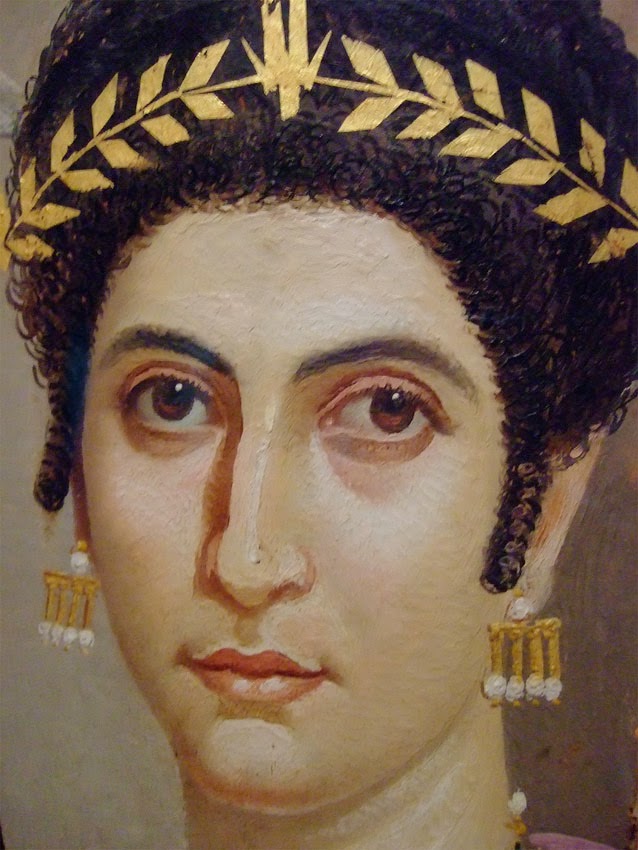
She was the daughter of Terentii Variones, a cousin of Varro and friend of Marcus Terentius Varro. She came from a very wealthy patrician family and her half-sister Fabia was a vestal virgin. Upon her father's death, she became very wealthy. She had a 400,000 sesterces dowry when she married Cicero. This became Cicero's, but she still had investments and land she managed on her own with her guardian Philotimus. In the late republic/empire, women had more rights and could manage their affairs with the help of a family member. It all did not go to the father/husband as it did before.
When Cicero married Terentia, he in essence married up in the social standing of the late republic. Terentia came from a patrician family, whereas Cicero came from a rural nobility. He was what was called a 'New Man,' someone who gained power on his own. In 78 BC, Terentia and Cicero had their first daughter Tullia and in 65 BC their son, Marcus Tullius Cicero. They only had two children. Some evidence I read suggested infertility issues between Terentia and Cicero, but with that said, they still had two children together. Terentia did not accompany Cicero when he went abroad to Sicily. She stayed back with young Tullia.
In 47/46 BC Terentia and Cicero divorced. Terential was 52 years old. Reasons for the divorce from Cicero are dishonesty in financial dealings. Cicero did not like how Terentia was handling her investments. Cicero feared for his sons financial future from Terentia's management of her lands and investments and or her treatment of Tullia. Or at least that is what the literature I have read has suggested. It is also pointed out that correspondence cooled between Terentia and Cicero. There was no formal letter declaring the divorce as was the custom at this time. The divorce was official none the less.
Her next husband after Cicero was Caius Sallustius Crispus, or the historian Sallust. From this point on she remarried two more husbands and lived to be 103 years old.
She was the daughter of Terentii Variones, a cousin of Varro and friend of Marcus Terentius Varro. She came from a very wealthy patrician family and her half-sister Fabia was a vestal virgin. Upon her father's death, she became very wealthy. She had a 400,000 sesterces dowry when she married Cicero. This became Cicero's, but she still had investments and land she managed on her own with her guardian Philotimus. In the late republic/empire, women had more rights and could manage their affairs with the help of a family member. It all did not go to the father/husband as it did before.
When Cicero married Terentia, he in essence married up in the social standing of the late republic. Terentia came from a patrician family, whereas Cicero came from a rural nobility. He was what was called a 'New Man,' someone who gained power on his own. In 78 BC, Terentia and Cicero had their first daughter Tullia and in 65 BC their son, Marcus Tullius Cicero. They only had two children. Some evidence I read suggested infertility issues between Terentia and Cicero, but with that said, they still had two children together. Terentia did not accompany Cicero when he went abroad to Sicily. She stayed back with young Tullia.
In 47/46 BC Terentia and Cicero divorced. Terential was 52 years old. Reasons for the divorce from Cicero are dishonesty in financial dealings. Cicero did not like how Terentia was handling her investments. Cicero feared for his sons financial future from Terentia's management of her lands and investments and or her treatment of Tullia. Or at least that is what the literature I have read has suggested. It is also pointed out that correspondence cooled between Terentia and Cicero. There was no formal letter declaring the divorce as was the custom at this time. The divorce was official none the less.
Her next husband after Cicero was Caius Sallustius Crispus, or the historian Sallust. From this point on she remarried two more husbands and lived to be 103 years old.